
An Automatic Detection Device for Floating Ball Valves (Part two)
Figure 3 illustrates the operating principle of the pneumatic system of the floating ball valve automatic detection device. The device is equipped with a dedicated cradle for mounting a nitrogen cylinder. Once on site, the cylinder (No. 7) is secured in the cradle and serves as the primary gas supply.
According to Boyle’s law (also known as the Boyle–Mariotte law), the gas charging process is assumed to be isothermal. Therefore, the relationship can be expressed as follows:
P₀V₀ = P1(V1 + V0) (1)
Where P0 is the initial pressure in the nitrogen cylinder (15 MPa).
V0 is the cylinder volume (L).
P1 is the target pressurization pressure in the hydrogen-side oil return control box (0.5 MPa).
V is the volume of the hydrogen-side oil return control box, taken as 340 L.
Based on Equation (1), the minimum required volume for the nitrogen cylinder is calculated to be 11.2 L.
However, considering potential leakage in the piping and the proportional pressure-reducing valve, as well as the need for multiple test runs, the system is equipped with two 40-L nitrogen cylinders.
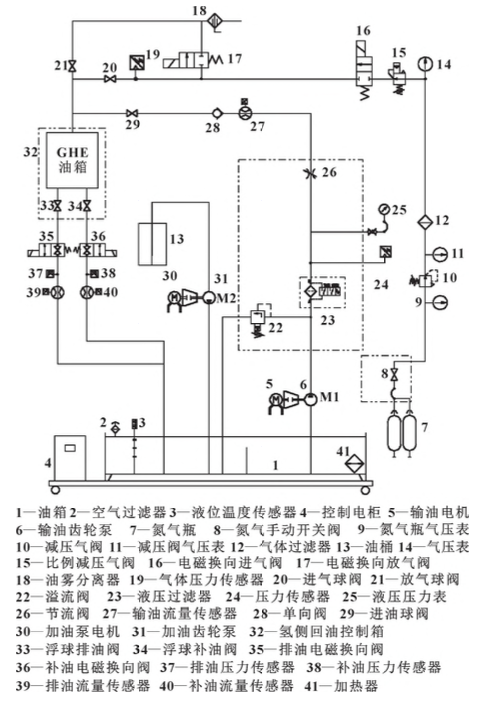
- Oil Tank
- Air Filter
- Liquid Level & Temperature Sensor
- Control Cabinet
- Oil Supply Motor
- Oil Supply Gear Pump
- Nitrogen Cylinder
- Manual Nitrogen Shut-off Valve
- Nitrogen Cylinder Pressure Gauge
- Manual Pressure-Reducing Valve
- Primary Pressure-Reducing Valve Gauge
- Gas Filter
- Oil Drum
- Pressure Gauge
- Proportional Pressure-Reducing Valve
- Solenoid-Operated Intake Valve
- Solenoid-Operated Exhaust Valve
- Oil Mist Separator
- Gas Pressure Sensor
- Intake Ball Valve
- Exhaust Ball Valve
- Check Valve
- Hydraulic Filter
- Pressure Sensor
- Hydraulic Pressure Gauge
- Throttle Valve
- Oil Supply Flow Sensor
- One-way Valve
- Oil Inlet Ball Valve
- Oil Filling Pump Motor
- Oil Filling Gear Pump
- Hydrogen-Side Oil Return Control Tank
- Float-Operated Oil Drain Valve
- Float-Operated Oil Replenishment Valve
- Solenoid-Operated Oil Drain Valve
- Solenoid-Operated Oil Replenishment Valve
- Oil Drain Pressure Sensor
- Oil Replenishment Pressure Sensor
- Oil Drain Flow Sensor
- Oil Replenishment Flow Sensor
- Heater
Figure 3: Principle of the Automatic Detection Device for Floating Ball Valves
After being released from the nitrogen cylinder, the high-pressure gas passes through the manual nitrogen shut-off valve (8) and enters the manual pressure-reducing valve (10) for primary pressure reduction, thereby reaching the required inlet pressure for the proportional pressure-reducing valve. After passing through the gas filter (12), the gas enters the proportional pressure-reducing valve (15) for secondary pressure reduction. In conjunction with the gas pressure sensor (19), a closed-loop control system is established to maintain the pressure in the hydrogen-side control tank at 0.5 MPa, even during fluid discharge.
The primary function of the hydraulic section is to inject oil into the hydrogen-side oil return control tank while simultaneously using sensors to monitor the opening status and flow rate in the oil lines, thereby determining the opening state of the float valve. To minimize the detection time, the pump output flow rate is set to 25 L/min. Considering the field installation requirements, including approximately 3 m of piping and an oil inlet elevation of about 2.5 m, a system pressure of 1.5 MPa was selected.
Consequently, the system power requirement is calculated as follows:

Where W represents the motor power (kW), PPP represents the total system pressure (MPa), Q represents the oil pump flow rate (L/min), and η represents the motor efficiency coefficient, taken as 0.9. Accordingly, a motor with a rated power of 0.75 kW was selected. The selected pump is rated at 1.5 MPa with a displacement of 19.3 mL/rev. The schematic diagram of the hydraulic section is shown in Figure 3. The device uses a refueling gear pump (31) to transfer oil from the oil drum to the internal oil tank. Once the oil level in the tank reaches the high-level mark, the transfer gear pump (6) draws the oil and delivers it to the hydrogen-side oil return control tank. A transfer flow sensor (27) accurately monitors the flow rate by measuring the rotation of its internal gears. A high-precision pressure sensor (37) and a discharge flow sensor (39) are installed downstream of the float-operated oil drain valve (33). When the float-operated oil drain valve opens, the pressure sensor and gear-type flow sensor record the corresponding pressure and flow data, thereby confirming successful valve opening. The operating principle of the float-operated oil replenishment valve is the same.
The control logic of the automatic float valve testing device is primarily based on the manual maintenance procedures for float valves. By selectively actuating different solenoid valves, the system simulates manual operations such as gas pressurization, oil filling, and valve closure. Flow and pressure sensors are used to detect the presence of oil in the hydraulic circuit, thereby determining the operating status of the float valve and triggering the subsequent testing phase. By integrating the readings from the flow sensors, the volumes of injected and discharged oil can be calculated, allowing the corresponding liquid levels to be determined. Although the device is capable of performing a fully automated testing sequence, manual verification by maintenance personnel is still required. Therefore, visual and audible alarms are activated during float valve level calibration and internal leakage testing.
After cross-checking the oil tank level with the magnetic flap level gauge on the hydrogen-side oil return control cabinet for secondary verification, the operator taps the touchscreen to initiate the next testing stage. The control process of the automatic detection device primarily consists of the following steps:
(1) The system checks whether the oil level and temperature in the device’s oil tank meet the operational requirements. If so, the operator is prompted to initiate testing; otherwise, the oil-filling pump motor (30) or heater (41) is activated.
(2) Once the operator taps “Confirm” on the touchscreen, the oil-discharge solenoid directional valve (35) and the air-vent solenoid directional valve (17) open, and the oil-delivery pump motor (5) starts. The oil-delivery flow sensor (27) begins calculating the injected oil volume. When the oil-discharge pressure sensor (37) indicates a value above 0.2 MPa and the oil-discharge flow sensor (39) indicates a value above 2 L/min, it is determined that the float-operated oil-discharge valve (33) is open. The current liquid level is recorded. The oil-delivery pump motor (5) and the oil-discharge solenoid directional valve (35) are shut off, and audible and visual alarms notify the operator that the float-operated oil-discharge valve (33) has successfully opened, indicating readiness for the next testing stage.
(3) After the operator taps “Confirm”, the oil-delivery pump motor (5) injects 10 L of oil.
Simultaneously, the air-vent solenoid directional valve (17) closes, the air-intake solenoid directional valve (16) opens, and the proportional pressure-reducing valve (15) regulates the air pressure to 0.5 MPa. The oil-discharge solenoid directional valve (35) opens. When the readings from the oil-discharge pressure sensor (37) and flow sensor (39) drop to zero, the outflow volume is calculated based on the flow sensor (39), thereby determining and recording the current liquid level. Audible and visual alarms notify the operator that the float-operated oil-discharge valve (33) has closed successfully.
(4) Following manual confirmation by the operator, the oil-replenishment solenoid directional valve (36) is opened. If the oil-replenishment flow sensor (40) indicates a flow rate above 2 L/min and the oil-replenishment pressure sensor (38) indicates a pressure above 0.2 MPa, audible and visual alarms are triggered, indicating excessive internal leakage of the float-operated oil-replenishment valve (34). Otherwise, the oil-discharge solenoid directional valve (35) is closed, and a message is displayed on the screen instructing: “Please manually open the float-operated oil drain override valve.”
Once the operator opens the float-operated oil drain override valve and selects “Confirm” on the touchscreen, the oil-drain solenoid directional valve (35) is opened. The program calculates the outflow volume based on the sensor readings from the oil-drain flow sensor (39) and the oil-replenishment flow sensor (40). When the flow rate detected by the oil-replenishment flow sensor (40) exceeds 2 L/min and the pressure detected by the oil-replenishment pressure sensor (38) exceeds 0.2 MPa, both the oil-drain and oil-replenishment solenoid directional valves (35 and 36) are shut off. This indicates that the float-operated oil-replenishment valve (34) has opened. The current oil tank liquid level is recorded, and audible and visual alarms notify the operator of the valve opening.
(6) After manual verification is completed, the oil-drain and oil-replenishment solenoid directional valves (35 and 36) are opened, allowing the test oil in the tank to return to the detection unit under pneumatic pressure. If a sudden surge in flow is detected by either the oil-drain or oil-replenishment flow sensor (39 or 40), the solenoid valves (35 and 36) are closed, indicating that the oil tank is empty. The pneumatic solenoid directional valve (17) is then opened. When the pressure sensor (19) detects that the pressure has dropped to zero, audible and visual alarms are triggered, indicating test completion. For steam turbine generator equipment, external connections to the electrical control system shall not be made arbitrarily, as this may interfere with the Distributed Control System (DCS). Therefore, the oil tank liquid level is determined by calculating the volume based on flow sensor data. By integrating the measured flow rate, the actual oil volume can be accurately obtained.

Where VVV represents the volume passing through the flow sensor (L), and ttt represents the flow duration measured by the sensor (min), defined as the time interval during which the flow sensor registers non-zero values. Q(t) represents the instantaneous flow rate recorded by the sensor (L/min). The hydrogen-side oil return control tank is a horizontal cylindrical tank with flat ends. Since the magnetic flap level gauge uses the tank’s horizontal centerline as its zero reference, with positive values above the centerline and negative values below, the relationship between tank volume and liquid level can be expressed as follows:

Where V represents the volume of the hydrogen-side oil return control tank (L), and rrr represents the tank radius (set to 280 mm). L represents the tank length, set to 1380 mm. h represents the vertical distance from the tank’s circular center to the liquid surface (mm), as illustrated in Figure 4.
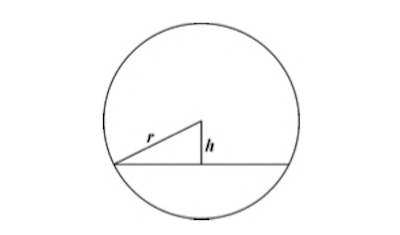
Figure 4: Schematic for calculating volume and liquid level in the hydrogen-side oil return control tank
Based on Equations (3) and (4), the liquid level in the oil tank can be determined from data collected by the flow sensor. Since the Process Indicator Controller (PIC) cannot perform this calculation, the system’s Programmable Logic Controller (PLC) is used to perform the required integration to determine the corresponding volume. The calculated volume is then displayed on the operator’s touchscreen, enabling manual verification against a reference table correlating tank volume with liquid level height.
The automatic detection device for float valves integrates the oil tank, pump motor, and valves into a single unit housed within a protective enclosure. Casters are mounted at the base of the oil tank to facilitate mobility to the designated test site. On the hydrogen-side oil return control tank, the upper oil/gas inlet ports and the lower float-operated oil replenishment and drain valves are connected via flanges, while the opposite end of the tank is connected to the main detection unit via quick-connect couplings. Electrical wiring uses aviation-style connectors for rapid and secure connection to the device, while the opposite ends are terminated with plugs for convenient connection to various sensors. To simplify nitrogen cylinder replacement, the device is equipped with an accumulator clamp to securely hold the cylinder in place. The cylinder is connected to a bulkhead fitting on the device via a flexible hose, thereby establishing the gas supply. The complete configuration of the automatic float valve detection device is shown in Figure 5.
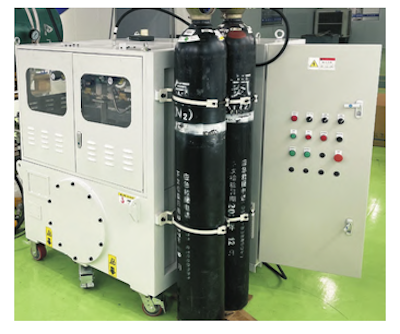
Figure 5: Automatic Detection Device for Float Valves
Once the automatic float valve detection device is properly installed, testing can be initiated via the control panel interfaced with the device. The detection control interface is shown in Figure 6. To verify the accuracy of the device’s liquid level calculation method, a comparative analysis was conducted. This analysis compared the readings from the magnetic flap level gauge on the oil tank, the liquid level data displayed in the DCS central control room, and the liquid levels derived from the volume readings on the device’s touchscreen using a lookup table. The results demonstrate that the device’s calculated data are more accurate than the readings from the magnetic flap level gauge. Consequently, the device is suitable for calibrating the opening and closing liquid levels of float valves in the hydrogen-side oil return control box. A comparison of the recorded liquid levels is presented in Table 1.
Table 1: Liquid Level Comparison for the Hydrogen-Side Oil Return Control Box
Liquid Level Designation | Visual Level Gauge | DCS | Device Calculation |
Oil Drain Valve Opening | 52 | 55.74 | 54 |
Oil Drain Valve Closing | 48 | 51.58 | 49 |
Oil Supply Valve Opening | -40 | -43.42 | -42 |
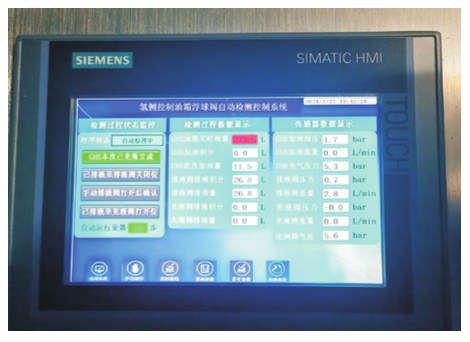
Figure 6: Control Interface of the Automatic Float Valve Detection Device
To verify the device’s ability to detect internal leakage in the float-operated oil supply valve, the forced-opening valve of the oil supply line was manually actuated during Step (4) of the procedure. The system promptly issued an alert indicating excessive internal leakage in the oil supply valve. Therefore, the automatic float valve detection device effectively enables automatic calibration of the opening and closing liquid levels of both the float-operated oil drain and supply valves. In addition, it allows operators to verify whether these valves operate correctly—i.e., open and close as intended—and to detect internal leakage faults.
Based on the manual maintenance procedures for float valves in the hydrogen-side oil return control boxes of turbine-generator dual-circulation seal oil systems, this study designs and develops an automated float valve inspection device. Verified through prototype fabrication and on-site field testing at a power plant, the device enables maintenance and precise calibration of the opening and closing levels of float valves in hydrogen-side oil return control boxes, effectively replacing manual inspection. The device features a simple structure, easy operation, and a high degree of automation, and requires no connection to the internal operational sensors of the turbine-generator unit, making it particularly suitable for power generation applications with stringent safety requirements. The implementation of this device enhances maintenance quality, economic efficiency, and operational safety during major overhauls. It also mitigates risks such as oil ingress into the generator rotor during gas-tightness testing and tripping of the hydrogen-side seal oil pump caused by critically low oil levels due to float valve anomalies. Consequently, it ensures the safe and stable operation of turbine-generator units and demonstrates strong potential for practical application in the power generation industry.

BALTIC VALVE CO., LTD supplies superior quality industrial valves covering ball valves, globe valves, gate valves, check valves, plug valves, butterfly valves, marine valves, forging steel valve, filter, etc.

Ventilation Butterfly Valves: A Practical Guide
Oct 18, 2026

Valve Reliability: Why It Beats Low Prices
Oct 10, 2026

How to Select Valves for Condensate Systems
Sep 30, 2026
Baltic Valve Co., Ltd.
Add: Baltic Valve Park, Siming, Xiamen, China.
Tel: +86 592 8266 140
Fax: +86 592 8266 440
Mail: [email protected]
Website: https://www.baltic-valve.com
Copyright © 2017-2026 Baltic Valve Co., Ltd. All rights reserved. Privacy Policy | Terms of Service
Website Design & Support: jeawin.com